
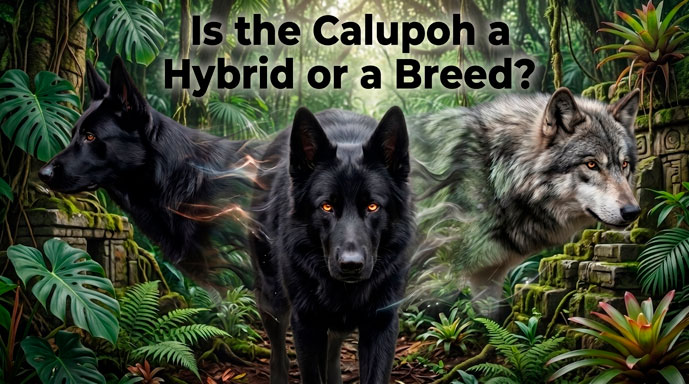
The Calupoh has been recognized as a breed since 2016 by the Federación Canófila Mexicana. However, some people still refer to it as a “hybrid”.
So, what is the truth?
To understand this, we first need to know what each concept actually means and why the Calupoh should no longer be considered a hybrid, but rather an officially recognized breed.
What is a Hybrid?
Hybrid is the result of crossing:
The goal of these crosses is usually to combine desired traits, such as coat type, size, temperament, or physical appearance.
The problem is that the results is not very predictable. You cannot know what percentage of each breed or species the puppy will inherit. Temperament can vary considerably, and physical traits may not appear consistently.
Each litter can be different. There is no fixed genetic stability.
And here is the key point: a hybrid does not have a fully established or guaranteed standard generation after generation.
What is a pure breed?
Una raza pura es un grupo de individuos con características genéticas estables y predecibles que se mantienen de generación en generación mediante una reproducción selectiva y controlada.
This means that:
Breeds are not random combinations.
They are the result of decades and sometimes centuries of intentional selection to achieve a specific outcome.
When you observe several individuals of same breed, they should share:
This consistency is what defines a breed. Because of it, you can anticipate:
With this information, you can understand whether the dog may adapt well to your family and, more importantly, whether you will be able to provide the environment and care it needs.
When does a hybrid become a breed?
This is a point that many people are aware of.
A hybridization project can become a breed when, after several generations of structured work, it manages to:
With these elements in place, the process to obtain breed recognition can begin.
But this does not happen in 2 or 3 generations. It requires:
Genetic stability is not improvised. It is built over time.
Requirements for international recognition
Todo este trabajo para debe de hacerse siguiendo los lineamientos de la Federación Cinológica Internacional (FCI), para obtener una línea estable, y cumplir con los requerimientos necesarios para realizar el proceso formal de reconocimiento de la raza.
According to the FCI, which is based in Belgium and has member organizations in more than 90 countries, recognizing a new breed generally requires:
These requirements help demonstrate that:
Calupoh: From hybrid to recognized breed
The Calupoh did not emerge as a trend. It began as a cultural recovery project.
In the 1990s, a structured program began with the goal of recovering the ancestral breeding technique of pre-Hispanic Mexico. The project sought to revive the symbolic image of the wolf-dog (known historically as loberro), found in historical remains, but adapted to modern life: a family dog with a stable and balanced temperament.
Mexico already has two recognized breeds of deep cultural value: the Chihuahua and the Xoloitzcuintle. The Calupoh was envisioned as a third Mexican breed honors this historical legacy.
In its early stages, the project involved controlled hybridization. However, the goal was always to create a new breed with its own identity, stable temperament, and defined characteristics.
And that is the difference.
It was not simply an isolated cross. It had a clear purpose, as many other breeds once did. It was a structured program.
Official recognition of the Calupoh
In 2016, the Federación Canófila Mexicana officially authorized the Calupoh as a breed.
To achieve this, the program presented:
This process confirmed that the Calupoh already met the criteria of genetic stability and homogeneity necessary to be considered a breed.
So, why do some people still call it a hybrid?
Mainly due to lack of information.
The fact that it began as a hybridization project does not mean it continues to be one.
Today, the Calupoh is not an experiment. It is a young breed that continues to consolidate itself, but within a formal and recognized framework.
What else would you like to know?
What question do you have about the Calupoh?
What myths would you like us to clarify in the next article?
Leave us a comment and help us continue sharing clear, responsible, and respectful information about this Mexican breed that is part of our cultural legacy.
We invite you to keep exploring our blog.