
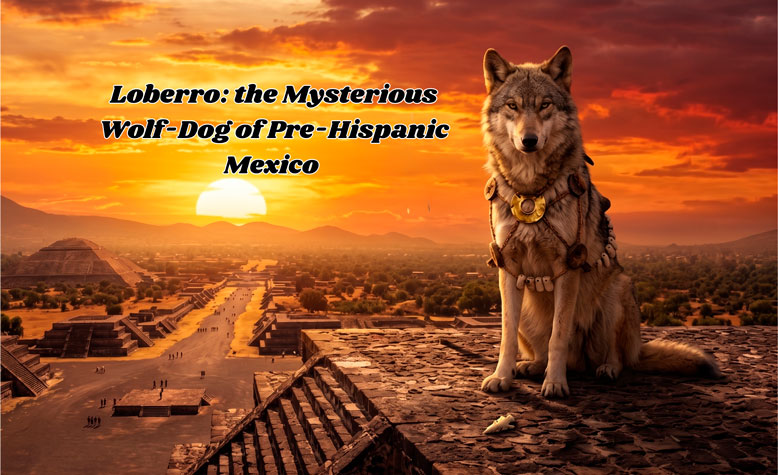
When we think of pre-Hispanic Mexico, we usually imagine temples, warriors, and gods. Yet among all these symbols, there is one far less know that has nevertheless captured the interest of archaeologists: the “loberros”.
The term may sound unfamiliar to many people. It does not appear in school textbooks and is rarely mentioned during tourist visits. But behind this word lies a fascinating story that connects archaeology, religion symbolism, and the relationship Mesoamerican cultures had with animals.
Loberros were not mythical creatures invented by modern legends. The terms was used by researchers to describe pre-Hispanic canids with intermediate characteristics between dogs and wolves. Their existence began attracting attention thanks to several archaeological discoveries made in central Mexico.
And although debates and interpretation still exist around them, one thing is clear: for pre-Hispanic cultures, these were not ordinary animals.
What does “Loberros” mean?
The word “loberro” was used by zooarchaeologists to refer to wolf-dog hybrids found in pre-Hispanic ceremonial context.
It is important to clarify that the term does not directly come from known Mexica or Teotihuacan sources. It is a modern designation created within zooarchaeological research to identify these canids discovering during excavations.
And this is where archaeology plays a fundamental role.
We often imagine archaeology simply as people excavating pyramids or discovering ancient objects. But in reality, it also involves anatomical analysis, bone comparisons, ritual context studies, symbolic interpretation, and even observations of cultural patterns.
In the case of the loberros, researchers did not immediately reach their conclusions. In fact, some remains remained unidentified for years.
The discovery that changed everything
The story officially began in 1978, when workers accidentally discovered the famous Coyolxauhqui monolith in downtown Mexico City.
Alongside the monolith, an offering containing a very unusual canid was uncovered.
Archaeologists noticed that it did not appear to be a typical dog. It was larger in size, its face had features closer to those of a wolf, and certain anatomical traits did not fully match those of a traditional domestic dog.
But it did not completely fit the characteristics of Mexican wolf either.
Representation of a loberro burial
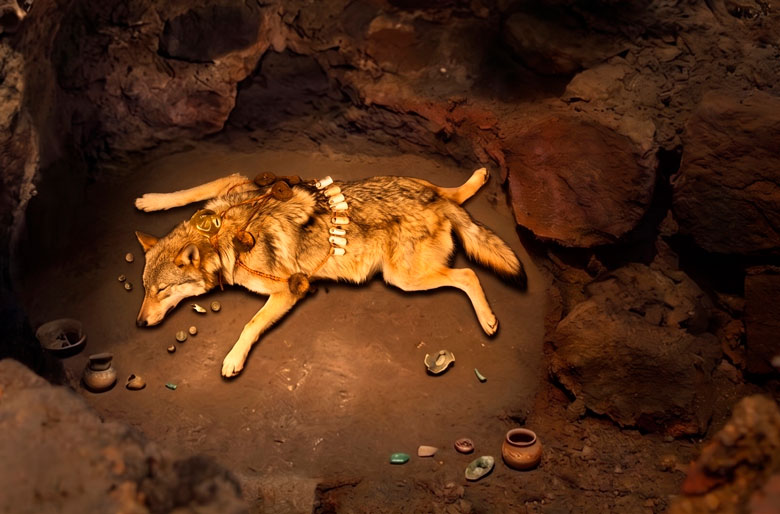
AI-generated image
For years, researchers could not classify it with certainty.
It was not until the 1990s, thanks to new investigations and comparisons with other remains found in Teotihuacan, that a stronger hypothesis began to emerge: they were likely looking at wolf-dog hybrids.
This detail is important because it demonstrates how archaeological research actually works.
Archaeology does not always provide immediate answers. Interpretation often change as new discoveries, technologies, methodologies, or addition evidence become available.
That means much of what we know about loberros is still being built today.
Why were these animals important?
This is where the subject becomes even more fascinating.
Archaeological studies suggest that loberros were not accidents on nature, random crosses, or mere curiosities. Everything points to them having deep ritual and symbolic significance.
For many Mesoamerican cultures, large predators represented divine forces. Wolves, jaguars, eagles, and other animals were associated with war, power, the Sun, the night, or the underworld.
Within this context, the wolf seems to have occupied a special place.
According to some archaeological interpretations of the Mesoamerican worldview, the dog represented rain, fertility, and good fortune, while the wolf symbolized strength, war, and blood.
The idea of combined both animals into one being may have held enormous symbolic value: uniting two opposing forces within a manageable body, yet with the attributes associated with the wolf.
Loberros and pre-Hispanic religion
One of the most important aspects for understanding loberros is the context in which they were found, as many of these discoveries appeared in highly significant ceremonial spaces.
Some were found near areas associated with the worship of Huitzilopochtli, the Mexica god linked to war and the Sun.
Others appeared in caves at Teotihuacan symbolically connected to the underworld. Certain remains discovered at the Pyramid of the Moon even show associations with the West, a direction related within their worldview to the nocturnal Sun, death, and the journey into the underworld.
In pre-Hispanic cultures, animal were not seen merely as wildlife. Many were considered divine representations or symbols connected to power and the sacred.
At Teotihuacan, numerous iconographic depictions and skeletal remains of canids appear linked to warrior symbolism and ritual practices. Traditionally, these have been interpreted as coyotes, but some recent zooarchaeological findings suggest that certain elements may actually be more closely related to wolves.
Additionally, some remains found in ceremonial contexts belonged to individuals associated with high social or military ranks.
Researchers believe that access to these animals, especially within important ceremonies or ritual sacrifices, may have been a sign of power.
How do Archaeologists believe Loberros were obtained?
Although no pre-Hispanic written records currently explain directly how these hybrids were obtained, may modern conclusions come from archaeological interpretations based on skeletal remains, ritual context, and cultural comparisons.
Some researchers propose that certain communities deliberately sought to cross domestic dogs with wild wolves. The process may have involved leaving a female dog in heat tied within an area know to be inhabited by wolves, and if “the gods so desired”, the dog would return carrying the divinity of the wolf.
Within their worldview, the birth of a litter of “loberros” may have been seen as a manifestation of divine favor. They were believed to be blessed by an animal that embodied the essence of both parents.
Between truth and interpretation
Talking about loberros also means understanding the limits of historical research.
On the web, exaggerated claims or theories are often presented as absolute facts. But archaeological reality is usually far more complex.
Researchers work with fragmented evidence: bones, burial contexts, iconography, anatomical studies, and cultural comparisons. From this, they build interpretations.
Some interpretations are strongly supported. Others remain open hypotheses still debated today.
And this does not diminish the subject, it makes it even more fascinating. Because every new discovery can change part of what we believe we know.
What relationship do Loberros have with the Calupoh?
Today, most people have never heard of loberros, less their relationship with the Calupoh.
And although both subjects are connected, it is important to clarify that the loberros found in archaeological contexts are not the same as the modern Calupoh Because the original domestic dogs that were used in those crossings no longer exist.
However, research into wolf-dog hybrids in pre-Hispanic Mexico does form part of the history and cultural inspiration behind the recovery of the breeding techniques that eventually gave rise to the Calupoh as a cultural recovery project.

For this reason, understanding what loberros were also helps us better understand the symbolic context surrounding this contemporary Mexican breed.
Final reflection
Archaeology is constantly evolving, and in the coming years new discoveries will likely emerge that help us better understand the role these hybrids played within pre-Hispanic thought.
What we still do not know:
Loberros represent one of those subjects where history, symbolism, and archaeology come together in a fascinating way.
Beyond debates about genetics or classification, these discoveries allow us to glimpse how pre-Hispanic cultures understood the animal world and its connection to the sacred.
They also remind us of something important: much of Mexico´s history still lies buried beneath the ground, waiting to be interpreted.
Every excavation, every analyzed bone, and every new investigation helps reconstruct fragments of a deeply complex and symbolic worldview.
And perhaps that is precisely what makes loberros so fascinating. They are not simply archaeological remains.
They are a window into the way our ancestors understood the relationship between nature, spirituality, and power.
What do you think about the loberros?
Would you like us to explore their relationship with Xólotl, Teotihuacan, or the modern Calupoh in greater depth?
Leave us a comment and continue exploring our blog to discover more about the history, symbolism, and cultural legacy of canids in Mexico.
Reference
- Valadez Azúa, Raúl et al. Una quinta raza de perro prehispánica o ¿una segunda especie de lobo mexicano? AMMVEPE Vol. 12, No. 5, 2001. Ir
- Valadez Azúa, Raúl et al. Híbridos de lobos y perros en cuevas teotihuacanas. Crónica de un descubrimiento. AMMVEPE Vol. 13, No. 1, 2002. Ir
- Valadez Azúa, Raúl et al. Híbridos de lobos y perros (tercer acto): hallazgos en la pirámide de Quetzalcóatl de la antigua ciudad de Teotihuacan. AMMVEPE Vol. 13, No. 6, 2002. Ir
- López Luján, Leonardo et al. Un portal al inframundo: Ofrendas de animales sepultadas al pie del Templo Mayor de Tenochtitlan. Estudios de Cultura Náhuatl 44, 2012. Ir