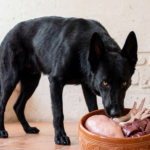
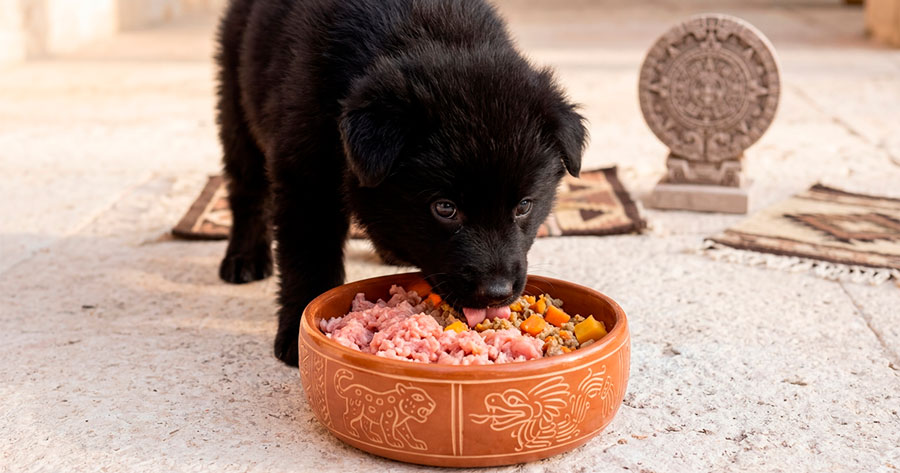
Two-month-old Calupoh puppies are very active and are in a crucial stage of their development.
During their first months, they grow very quickly. Their bodies are developing strong bones, which makes calcium intake and important part of their skeletal development. However, at this age their teeth are not yet strong enough to chew bones, so bones must be given ground.
But let´s go step by step.
How much should a 2-month-old Calupoh puppy eat?
The daily BARF amount should be approximately 10% of the puppy´s body weight. Of this amount, 70% to 80% should be animal protein and 20% to 30% vegetable.
For example:
If your puppy weighs 8 kg (17.6 lbs):
Of which:
It is important to monitor your puppy´s every two weeks and adjust portions according to activity level and growth.
Raw or cooked meat: Which is better?
One of the most common questions about natural feeding is whether meat should be given raw or cooked.
In the case of Calupoh puppies, their digestive system is capable of digesting raw meat. However, it is recommended to heat the meat in the microwave for at least 5 minutes to reduce bacterial load.
The final decision depends on the quality and hygiene of the meat. If you are not certain about its quality, it is safe to cook it lightly or fully.
When choosing between raw or cooked meat, consider the following:
Another important factor is the fat content of the meat. If the meat contains too much fat, diarrhea may occur, so part of the fat should be removed.
The importance of calcium at this stage
Calcium is essential during the first months of life. It helps support the formation of strong bones and a proper body structure.
Puppies naturally obtain calcium from raw bones. However, if raw bone is not included in the diet, calcium may need to be provided through supplements under veterinary supervision to avoid nutritional imbalances.
What about their stool when eating meat?
When a puppy eats fresh meat, it is normal for their stool to be less firm than when eating kibble. This does not necessarily mean something is wrong.
However, you should monitor for the following signs:
These may be warning signs, and it may be time to review the diet and consult a veterinarian.
But… can a Calupoh eat kibble?
Yes, it can.
Kibble can be included in a Calupoh´s diet. Ideally, it should be high in animal protein and low in grains. In some cases, puppies may require a slightly larger portion than amount suggested by the manufacturer.
When-formulate kibble can provide nutrients that may not always be perfectly balanced in a poorly planned homemade diet. However, it is important to understand something:
Kibble does not replace meat, it can work as a complement, but not as a substitute
Another important point is that kibble and meat should not be mixed in the same meal, because they have different digestion times and may cause digestive issues. They should be offered at different feeding times.
At this age, kibble should also be slightly soaked in water to make it easier for the puppy to eat.
A practical advantage of getting your puppy used to kibble is that it makes travel or situations where fresh food cannot be prepared much easier.
Now that we understand how each type of food can be integrated into a puppy´s diet, let´s look at some basic recipes that can help guide your puppy´s nutrition.
3 Basic natural recipes for 2-month-old Calupoh puppies
Recipe 1: Raw chicken with sweet potato and carrot
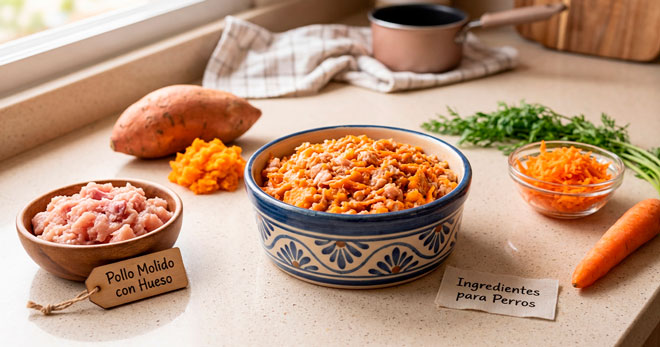
Ingredients:
- Ground chicken with finely crushed raw bone
- Cooked and peeled sweet potato
- Cooked and peeled carrot
Preparation:
- Wash and peel the sweet potato and carrot.
- Boil them in water without salt or seasoning until soft.
- Mash or cut the vegetables into small pieces.
- Mix with the ground raw chicken containing finely crushed bone.
The bone must be raw and completely ground. Never offer cooked bone.
Recipe 2: Cooked chicken with sweet potato, carrot and peas
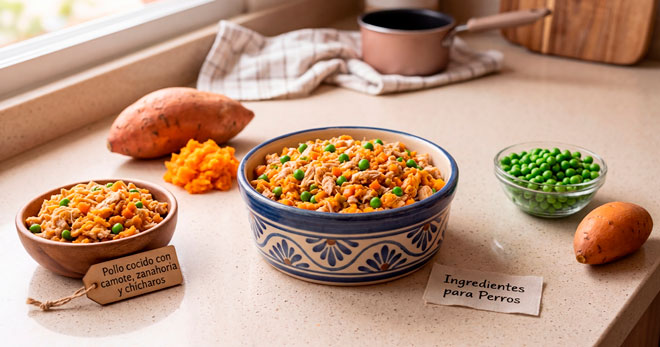
Ingredients:
- Cooked chicken without bone
- Peeled and cooked sweet potato
- Cooked and peeled carrot
- Cooked peas
- ¼ teaspoon eggshell powder (1-2 times per week)
Preparation:
- Boil eggshell for 10 minutes, remove them from the water, and let them dry. Then grind them into a fine powder.
- Wash and peel the sweet potato and carrot.
- Cook all vegetables in water without salt or seasoning until soft.
- Mash or cut the vegetables into small pieces
- Cook the chicken in water without salt or seasoning.
- Remove the bones.
- Cut the chicken into small pieces.
- Mix all ingredients together.
- Serve at room temperature.
Eggshell powder provides calcium when raw bones are not included.
Recipe 3: Raw chicken with carrot and peas
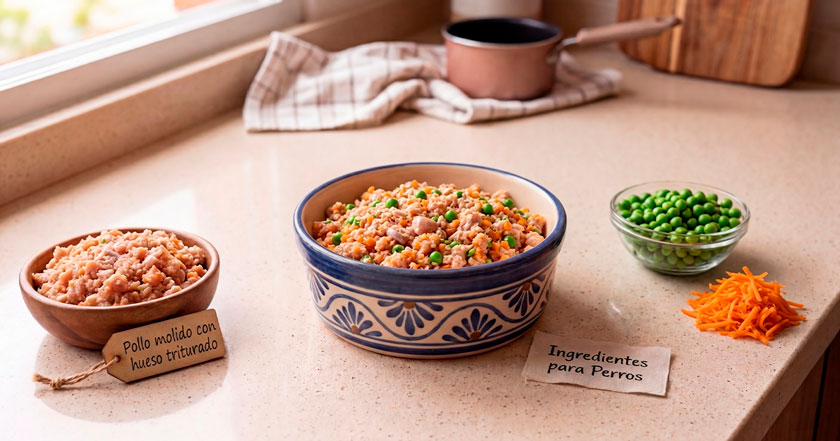
Ingredients:
- Ground chicken with finely crushed raw bone
- Peeled and cooked carrot
- Cooked peas
Preparation:
- Wash and peel the carrot.
- Cook the vegetables in water without salt or seasoning until soft.
- Mash or cut vegetables into small pieces.
- Mix with the ground raw chicken containing finely crushed bone.
The bone must be raw and completely ground. Never offer cooked bone.
Warning signs
Consult veterinarian if you notice:
Always introduce diet changes gradually.
An important note about the Calupoh
The Calupoh is a rare breed, and not all veterinarians are familiar withs its specific needs. Because of this, there may be different opinions regarding BARF-type diets.
The most important thing is not to follow trends, but to understand the specific needs of the breed, monitor the puppy´s development, and maintain a well-structured and supervised diet.
If you would like to learn more about:
We invite you to explore more articles in our Blog and continue discovering specialized content about the care and development of the Calupoh.
Now we would love to hear from you.
Share your experience or leave your questions in the comments.